Descripción del Producto
Introducción de Mini Rotary Compressor Direct Driven Industrial Screw Air Compressor
Compresor de aire de 300 bar
Velocidad de carga: 100 L/min
Presión de trabajo: 225 Bar – 300 Bar
Accionado por: Motor eléctrico trifásico zmwm02
El compresor de aire respirable MCH-6 de 300 bar es el compresor de aire respirable portátil más pequeño y ligero de la industria. Su motor de gasolina, de tan solo 37 kg, cabe fácilmente en el maletero de un coche y es fácil de transportar. Se puede utilizar en incendios, buceo, tiro, rescate de emergencia, industria química, yacimientos petrolíferos y otros sectores. El MCH6 ofrece alta calidad y un diseño portátil y sencillo. Su salida de aire comprimido cumple con la norma EN12571.
Estructura del producto de Mini Rotary Compressor Direct Driven Industrial Screw Air Compressor
Motor de gasolina opcional, motor de accionamiento eléctrico trifásico, monofásico, transmisión por correa trapezoidal
Compresor de alta presión de cuatro cilindros de nivel 4
Enfriador de acero inoxidable entre cada nivel.
Instalado en el manómetro del compresor de alta presión de 400 bar.
1.2 CZPT high pressure air tube, joints according to the needs of you
Cubierta de ventilador de acero inoxidable
Dos separadores de aceite y agua, 2 válvulas de drenaje (descontaminación automática opcional)
Sistema de filtración por tamiz molecular de carbón activado
Para configurar la parada automática de presión, evite que la válvula de alivio gire con frecuencia y garantice la seguridad.
Parámetro principal de Mini Rotary Compressor Direct Driven Industrial Screw Air Compressor
| Modelo | MCH-6/ET STHangZhouRD |
| Tarifa de carga | 100 l/min - 6 m³/h - 3,5 m³ |
| Presión del tiempo de llenado | 6,8 l 0-300 bar/20 min 10L 0-200 Bar/20 Min |
| Presión de trabajo | 225 bar/3200 psi 300 bar/4700 psi |
| Impulsado por | Motor eléctrico trifásico |
| Fuerza | 3 kW |
| Dimensiones | Alto: 35cm Ancho: 65cm Fondo: 39cm 35*65*39cm |
| Peso | 39 kilos |
| Presión de ruido | 83 dB |
| Número de etapas y cilindros | 4 |
| Capacidad de aceite lubricante | 300 cc (0,3 L) 300 ml |
| Lubricante | Aceite Coltri CE 750 Aceite Coltri CE 750 |
| Marco | Acero recubierto de polvo |
| Separador de aceite/humedad | Después de la última etapa |
| Filtración | Cartucho de filtro de carbón activado y molécula |
| Amperaje de carga completa | 11,5 A (230 V-50/60 Hz) 6,7 A (400 V-50/60 Hz) |
| Enfriadores entre etapas y postenfriadores | Acero inoxidable |
| Respirar aire | EN 12571 CGA |
| Filtro de succión | 2 micropapeles – 25 micropoliésteres |
| Amperaje de carga completa | 11, 5 A (230 V – 50/60 Hz) 6, 7 A (400 V – 50/60 Hz) |
| Válvula de seguridad | En la carcasa del separador |
Fotos de Mini Rotary Compressor Direct Driven Industrial Screw Air Compressor
| Estilo de lubricación: | Lubricado |
|---|---|
| Sistema de refrigeración: | Refrigeración por aire |
| Fuente de energía: | Alimentación de CA |
| Posición del cilindro: | Angular |
| Tipo de estructura: | Tipo cerrado |
| Tipo de instalación: | Tipo móvil |
| Personalización: |
Disponible
|
|
|---|
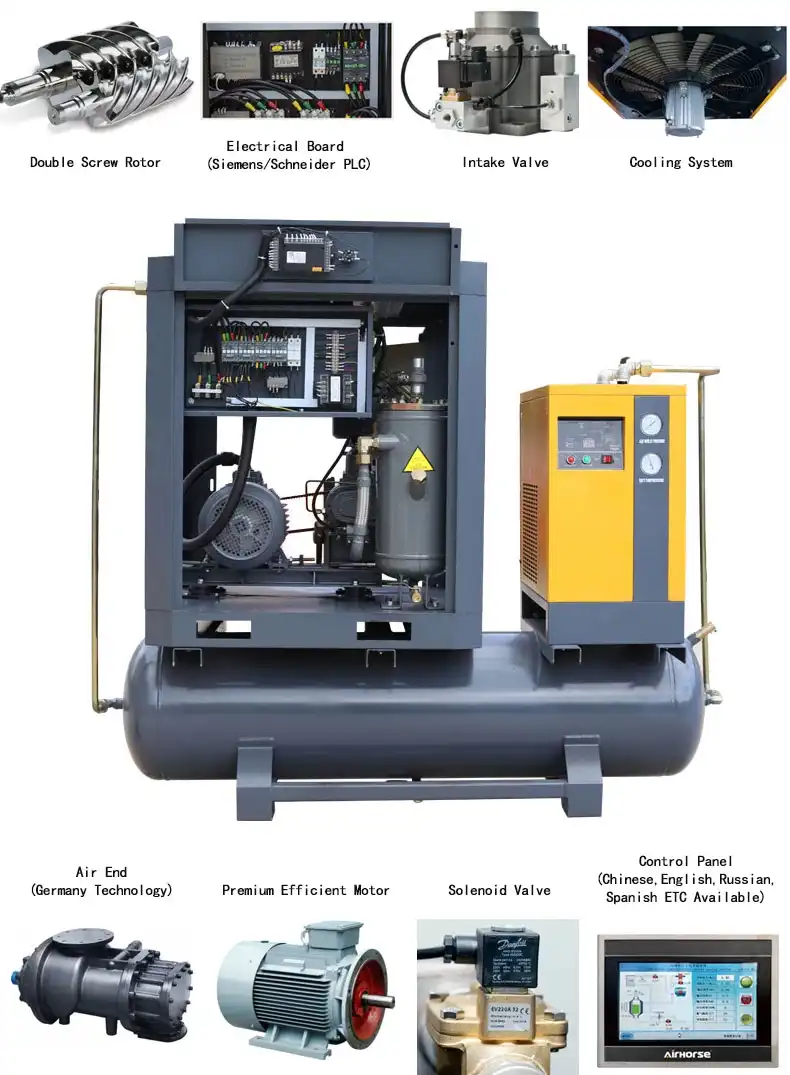
The Air Compressor Is a Versatile Tool
The Air Compressor is one of the most versatile tools in any garage or workshop. It is easy to use and can perform a variety of tasks, from jackhammering to drilling. These machines are available in a wide variety of sizes and types, making it an excellent choice for a variety of situations. With a single motor, you no longer need separate motors for each tool. Its lightweight, compact design makes it easy to handle, and the single motor also reduces wear on parts.
Oil-injected
Oil-injected air compressors require a large amount of lubricant, which needs to be added to the sump regularly to maintain optimum performance. As there are many types of industrial fluids, a well-intentioned maintenance technician may add the wrong lubricant to the compressor. If this happens, the compressor will become incompatible with the lubricant, resulting in excessive carryover and the need to flush and replace downstream air treatment components.
Typically, the G 110-250 oil-injected rotary screw compressor from Atlas Copco provides reliable compressed air, preventing costly downtime. The G110-250 oil-injected rotary screw compressor is highly reliable and durable, enabling it to function in temperatures up to 46degC/115degF. Despite the oil-injected air compressor’s robust design, this unit requires very little on-site installation, and it features simple operation.
The primary advantage of oil-injected air compressors is the reduced cost of running. The cost of oil-free compressors is less than half of that of oil-injected ones, and it will require fewer maintenance costs in the long run. Moreover, the oil-free system is more environmentally friendly than oil-injected air compressors. But the drawbacks of oil-injected air compressors are substantial, too. It can contaminate finished goods and cause a significant financial risk for the manufacturer.
An oil-injected rotary screw air compressor offers several advantages over its counterpart. First, it features an innovative vertical design with variable-speed drive, allowing it to run more efficiently. Second, oil-injected air compressors reduce energy consumption by up to 50% compared to non-oil-injected air compressors. They also have a thermostatic valve, allowing them to maintain an optimum temperature. Thermostatically-regulated oil coolers allow the compressor to run more quietly.
Sin aceite
What is an oil-free air compressor? The name refers to a type of air compressor that does not contain oil in the compressor chamber. Oil-free air compressors still use oil for various purposes, including lubricating the moving parts and managing waste heat. However, many people do not realize that their air compressor still requires oil for proper functioning. This article will explore why this type of air compressor is preferable for many users.
First of all, oil-free air technology has many benefits. For one, it reduces the energy cost involved in filtering air, and it minimizes leaks. Moreover, it also reduces the oil costs associated with compressor refills. And finally, it reduces the risks of contamination. Oil-free air technology is the future of compressed air. If you’re looking for an oil-free air compressor, here’s what to look for in your search.
Depending on the purpose of your air compressor, it may be beneficial to invest in an oil-free air compressor. Oil-lubricated air compressors are generally more durable than their oil-free counterparts, but they may cost twice as much. You should still consider the cost of ownership before purchasing an oil-free compressor. The oil-free models can be easier to transport, and they are more powerful. Moreover, they’re quieter than oil-lubed models.
An oil-free air compressor also means less maintenance, as it doesn’t need oil to work. This type of air compressors also features fewer moving parts, which means fewer places for problems to develop. All oil-free air compressors are manufactured to meet ISO Class 0 and 1 air purity standards. They also have less noise and vibration compared to their oil-based counterparts. So, why not choose an oil-free air compressor for your business?
Gasoline
When choosing a gas-powered air compressor, it’s important to consider the advantages of gasoline. This energy source can power a large air compressor without electricity. However, this type of air compressor lacks electrical hookup, so you’ll need to run an extension cord if you need to use it at a distance. However, gas compressors are able to function with just a gas tank. This makes them ideal for medium to heavy-duty industrial applications.
Another important consideration when choosing a gas air compressor is its size. Larger compressors are typically larger than portable ones and require more space. This makes them easier to transport and operate on the go. However, if you’re not sure which type of air compressor is best for you, consider the gas-powered versions. While they may be lighter, they don’t run as smoothly as their electric counterparts. Gasoline-powered compressors are not as portable as their electric counterparts and require proper maintenance.
Electricidad
Electricity in an air compressor is not cheap. A 25 HP air compressor runs for ten hours each day, five days a week. The motor in these machines consumes 746 watts per hour. To find out how much electricity the equipment uses, multiply the wattage by the running time. For example, if the compressor runs for three hours, then it will use 1.9 kilowatt hours of electricity. To determine how much electricity an air compressor uses per day, you can calculate the kilowatt hours and multiply the number by the utility rate. Considering this, you can determine the cost of running your air compressor once per month.
The cost of operating an air compressor depends on the type of compressor. Electric air compressors are often silent and can run without any maintenance. These tools can be left unattended for up to four thousand hours before requiring repair. Electric air compressors require higher power for higher pressure, so you should plan accordingly. Whether or not you need a maintenance visit is up to you, but the benefit of not having to spend a fortune on repairs is priceless.
Although compressed air is not an energy-efficient source, its use in a variety of applications may save you money and kilowatts. Since an air compressor uses power when it is running, the cost is lower than the cost of operating a power tool. If you plan to use your air compressor for a long time, make sure that it is maintained properly. Proper care will save you money and power, and you may even be able to get an extended warranty if the compressor breaks down.
Variable frequency drive
The main purpose of a variable frequency drive (VFD) in an air compressor is to reduce energy consumption in the process of compression. A single motor drag system cannot adjust its speed continuously according to the weight of the load. By applying frequency control to the compressor, the power consumption can be reduced while maintaining the same pressure level. Therefore, a VFD is an excellent choice for compressors. Its benefits are numerous.
A VFD can also monitor the temperature of the motor and send error signals if the motor is running too hot or too cold. This eliminates the need for a separate sensor to monitor the oil pressure. These functions are useful not only in lowering energy consumption, but also in improving the performance of an application. Moreover, a VFD can monitor additional variables such as temperature and motor speed. Hence, it is a useful investment.
When using a VFD, it is crucial to choose the right motor. The speed of the compressor should be within the maximum starting limit of the motor. The air tank may be of any size, but a constant pressure limit is required to keep the VFD running within the service factor of the motor. In addition to a VFD, a master controller should also include a remote pressure set point and a PID card for a master controller. The transmitter should incorporate all useful data from the VFD, including the speed and the oil temperature. The VFD must be tested before it is integrated with the master control. It should be tested for min and max speed, temperature, and current within the expected range.
The use of a VFD in an air compressor has many benefits. One of the most notable is the reduction in power consumption. Fixed-speed compressors run on set points of six to seven bar. An extra bar of compression uses 7 percent of energy. This energy is wasted. A VFD-powered air compressor can also increase the life span of compressor parts. It is one of the best investments in your compressor. So, why wait any longer?


editor by CX 2023-06-07